Prima Apparata #1 — When Ballet Meets Mechs in Olivia Dufault’s Celestial Debut

Earth is broken, and humanity’s survival hinges on a deadly dance. At the Conservatory, young pilots train to become ballerinas of the apocalypse. Olivia Dufault and Rebekah Isaacs launch a stunning new space opera where performance is war and perfection has a price.
There is a specific kind of magic that happens when a debut writer and a veteran artist click on the first page. You can feel the world expanding around them, alive and waiting. This week, that magic is landing in the form of Prima Apparata, a new series from Ignition Press that promises to be as visually arresting as it is narratively complex. If you’ve been waiting for a sci-fi entry that feels fresh, strange, and utterly immersive, this is the one to watch.
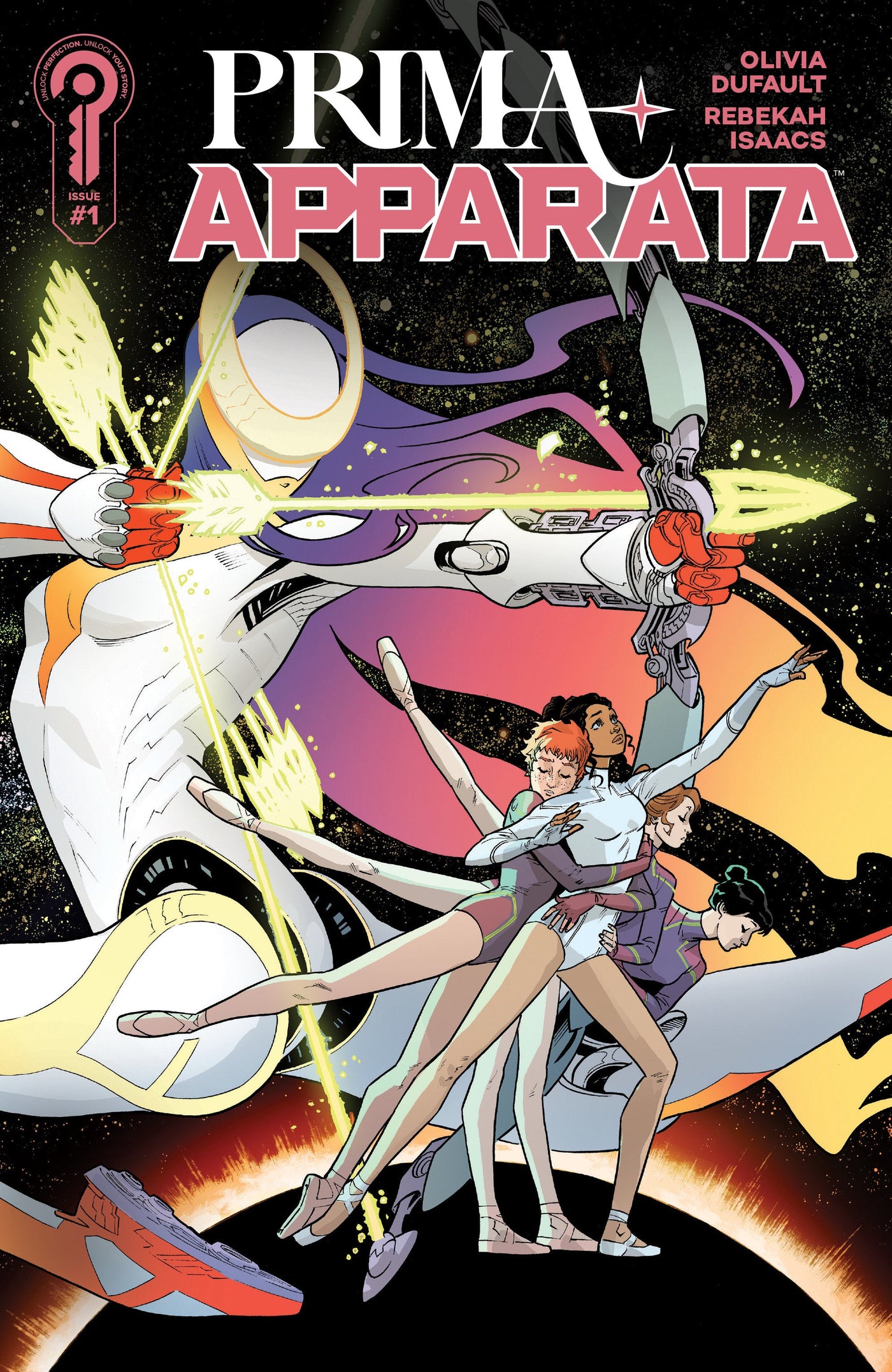
The setup is breathtakingly original. Earth has been shattered, leaving humanity to cling to survival in pockets across the galaxy. But salvation doesn’t come from soldiers—it comes from students. They train at the Conservatory, a prestigious celestial boarding school where the most talented young women are forged into the next generation of mech pilots. But here’s the twist: they aren’t built for war. They are ballerinas. Their mechs are designed for performance, not destruction, and their annual life-or-death recital is the only thing that unites the cosmic patrons who rule over them.
At the center of this high-stakes stage are Mar and Rhea, two recruits at opposite ends of the spectrum. Mar is quietly ambitious, driven by a desire to prove herself, while Rhea is a rebel who refuses to play by the rules. As they navigate a cutthroat curriculum, their bond deepens, pulling Mar into the orbit of Appolyta, the goddess whose tragic hunt is reenacted in every performance. The line between artistic expression and indoctrination begins to blur, revealing the heavy personal cost of pursuing perfection in a world that demands it.
This is where Olivia Dufault and Rebekah Isaacs shine. Dufault, known for her work on FX’s Legion, brings a psychological depth to the narrative that feels earned and intricate. Isaacs, whose art has defined titles like BRZRKR: Fallen Empire, provides the visual backbone that makes the Conservatory feel tangible and terrifying. Their collaboration creates a vibe that is equal parts elegant and oppressive—a place where every move is a weapon and every smile is a lie. It’s a space opera that understands the power of silence as much as it does the roar of an engine.
As a curator’s aside, I’d point to the cover art by Isaacs as a must-see. It captures the duality of the series perfectly: the grace of the dancer and the might of the mech, wrapped in a single, haunting image. Keep an eye on how the color palette shifts as the characters’ mental states fray—it’s a detail that speaks volumes without saying a word. This is a story that trusts its reader to catch the nuances, and it delivers on every promise.