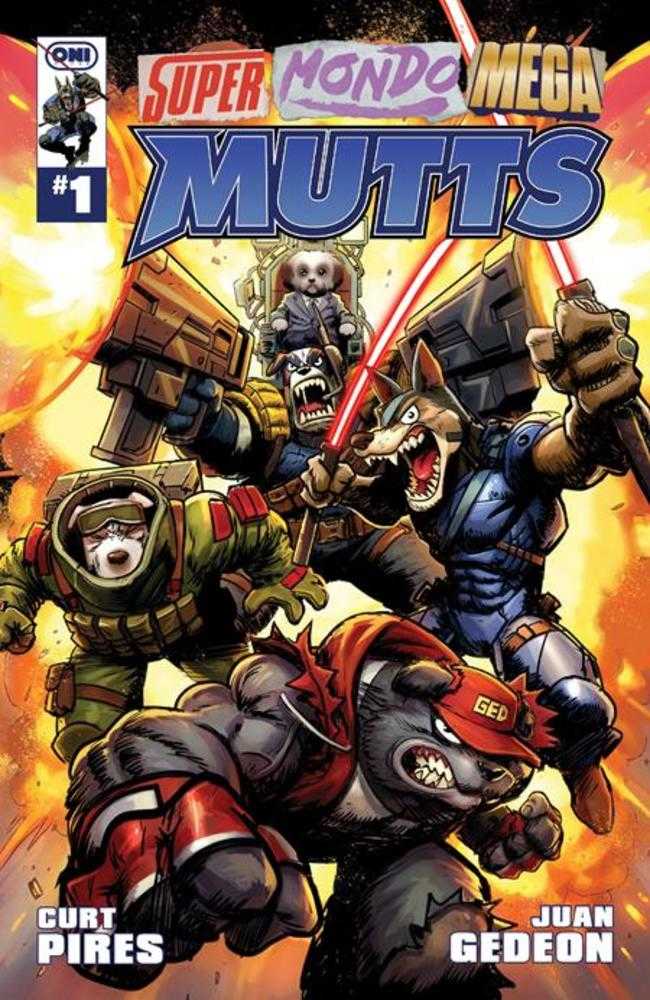
Super Mondo Mega Mutts #1 — Curt Pires and Juan Gedeon turn research dogs into LA's most dangerous vigilantes.

An interdimensional shard hits downtown LA, creating a no-man's-land where physics breaks down. The government sends in research dogs to find weapons, but gets something else entirely. Curt Pires and Juan Gedeon launch Super Mondo Mega Mutts, a raucous team of empowered canines ready to strike back against federal forces and alien-empowered gangs.
Downtown Los Angeles just got a crater that breaks physics, and the government's solution is to throw four lab-grade dogs into the zone to scavenge alien tech. They're counting on the animals to stay obedient while the laws of reality dissolve. Curt Pires and Juan Gedeon know exactly how that math works out, and it involves way more teeth than the contractors bargained for.
The result isn't a weapon. It's Wolf, Frankee, Griffy, and Freddy. They're anthropomorphic antiheroes who've turned a government experiment into a revolution. Backed by the brilliant mentor Mojo, this crew has carved out a territory where they call the shots. The Gleam is now their domain, a place where the outcasts and the armed gangs with alien tech are clashing. The mutts have decided that the avenues and alleyways need justice, and they're the ones handing it out.
This is a double-sized, 40-page debut that gives the creative team plenty of room to establish the world and the stakes. Gedeon brings the kinetic energy you've seen in DC: The Jurassic League, applying that same grounded dynamism to the animal action so every impact lands. Pires channels the unapologetic punch of Lost Fantasy, ensuring the dogs aren't just cute mascots but rough-edged vigilantes with a mission. The format and the creators align to make this an essential launch.
Gedeon's cover sets the visual standard immediately—bold, chaotic, and promising exactly what the story delivers. For the close reader, the payoff comes in how the art handles the zone's warped reality versus the streets. Gedeon uses the physics-breaking environment to push the visual language, making the action pop in ways that standard cityscapes can't. It's a detail that rewards the stack, and it's the kind of work that makes this issue a must-have.